The Facts—Confronting our local and statewide crisis
Experts, researchers, and the state of California all agree that we are in a housing crisis. What we should do about it, though, is a hotly contested subject. Discussion about the best policies is healthy and necessary; however, it is important that we debate with the same set of expert-verified facts about our situation. Thus, Cupertino For All has compiled a list of facts (with plenty of sources) to form the basis of our arguments for housing. Read on to understand how addressing the housing crisis in Cupertino can make our city more equitable, more sustainable, and a more vibrant place to live.

Fact: We need to build more housing to reach California’s goals
California has estimated that it will need to build 2.5 million more units in the coming eight years to make housing more affordable and account for population growth. This number is double what the state has currently planned.
Thankfully, California has made some headway with building new housing; it has already built around seven hundred thousand units in the past six years. Yet, these numbers have not been enough. In fact, California’s owner and rental vacancy percentages dropped. Joel Berner, economist at Realtor.com explained that “[California] was in such a deep hole that the recent successes in homebuilding are not enough to truly move the needle.” Furthermore, this slight boom in building hasn’t helped everyone equally. Only half of the 1.2 million units planned are deed-restricted for households that make below the area’s median income.
This statewide trend of not building enough affordable housing can be directly observed in Cupertino. Although Cupertino has done a fairly good job entitling market-rate homes (though not all of those properties are being built), it has fallen behind on their RHNA requirements for moderate and low income housing. Because of this, the City is currently in jeopardy of being found out of compliance with their Housing Element through No Net Loss Law, which could subject the city to costly litigation and Builder’s Remedy.
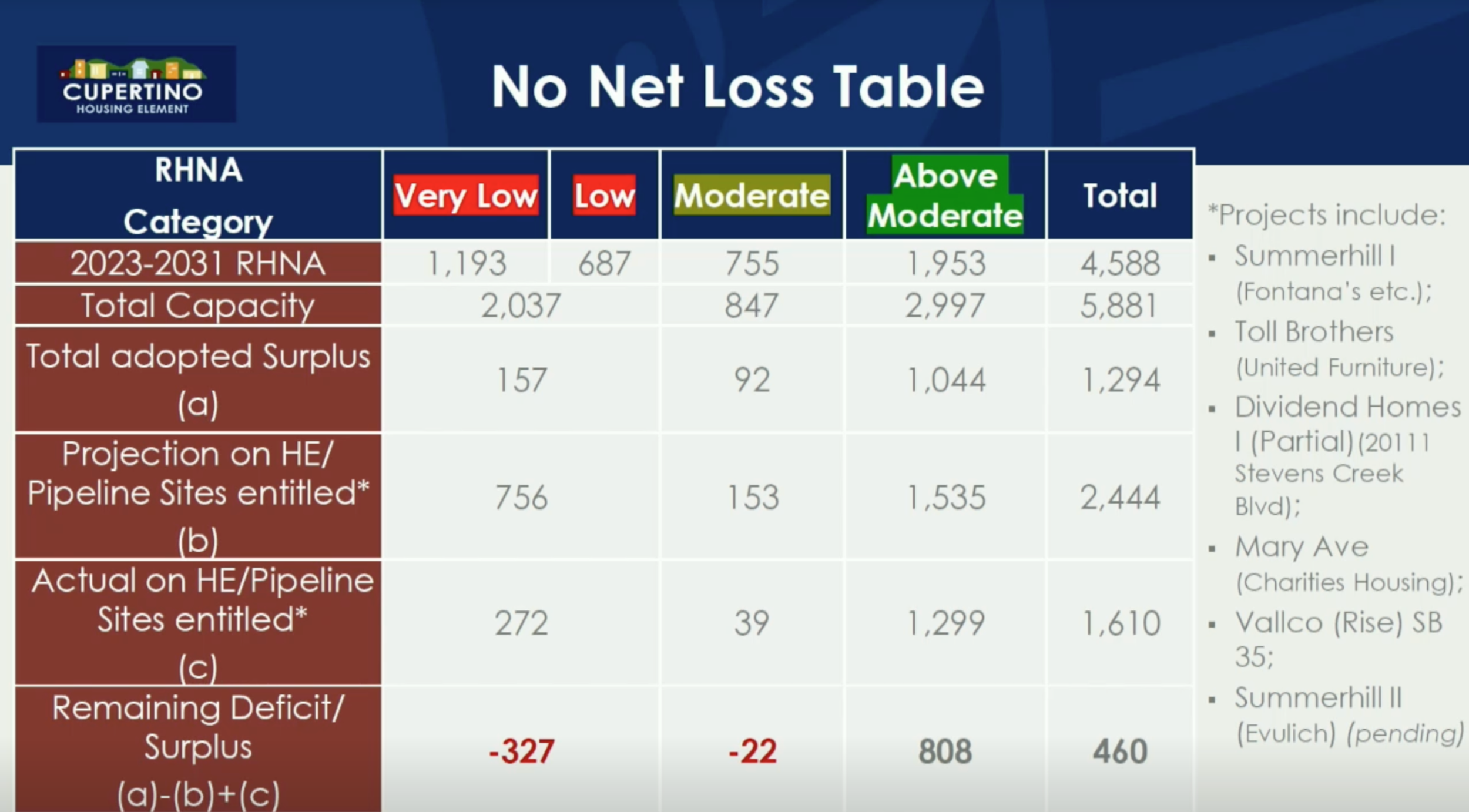
Image from March 3, 2026 City Council meeting
Fact: Our existing housing has become unaffordable for most
California’s median house price is two and a half times higher than the median national house. Furthermore, California has the most expensive rents in the nation with a median rent of $2,895. In particular, the South Bay (San Jose-Sunnyvale-Santa Clara metro area) has the highest median rent among large metro areas at $3,865. It isn’t just luxury or high end housing, either. A bottom tier home in California is 30% more expensive than a mid-tier home in the rest of the US. In total, the Common Sense Institute ranked California as 50th in affordability, just ahead of Hawaii.
Cupertino is no exception to this trend. Payscale has found that Cupertino’s cost of living is 147% higher than the national average, with housing prices in particular being 441% higher. The median house price in Cupertino was close to $3 million, while the median rent was over $8,500.
As a result of these sky-high costs compared to the rest of the country, California has the highest share of homeowners who spend more than half of their income on housing costs (14%), and the third highest share of renters who spend more than half of their income on housing costs (28%). More than half of California renters spend at least 30% of their income toward rent, making them rent burdened. In total, the Common Sense Institute found that California households lose 7.1% of gross income to higher prices and has concluded that California’s affordability crisis is “overwhelmingly a shelter problem”.

Fact: A lack of housing has been devastating for CUSD
In 2022, Cupertino Unified School District had to close two elementary schools, Meyerholz and Regnart, as well as consolidate Muir Elementary, due to declining enrollment. The district has lost over five thousand students since 2015, and expects to lose another four thousand students in the next eight years. The CUSD communications Director Erin Lindsey told NBC Bay Area that this drop in enrollment has been because of “the price of homes, empty nesters staying in their homes for longer, [and] lack of affordable housing”.
Additionally, declining enrollment has led CUSD into deficit spending, prompting cuts for middle school electives, staff pay, and reduced hours for transitional kindergarten.

Fact: The Bay Area’s youth are being hit particularly hard by our current housing crisis
Many students at community colleges and state universities in the Bay Area cannot afford to live directly on campus, due to high boarding costs. In many cases, students must choose between going to university and having shelter, which ultimately forces students to drop out due to financial difficulties.
Students in Cupertino have no shortage of financial struggles. A survey in 2024 ran by De Anza college found that 47% of respondents had experienced housing insecurity in the past year, which was an increase from 29% from two years prior. More concerningly, 18% of respondents reported homelessness in the past year. Even for students who can afford to find housing in the South Bay, they are often competing with families and groups of richer students who can afford to split the costs. Ultimately, the lack of affordable options for students affects their quality of life. A 2023 study found that when students are under high economic stress, they often choose housing far away from their college. This disconnects students from the campus community, which has documented benefits for academic success and wellbeing.
Students’ financial difficulties are backdropped by the larger, national shift in first-time home buying. It has hit a record low of just 21% of active home buyers, while the average age of a first-time home buyer has climbed to a record high age of forty years old. The National Association of Realtors estimates that delayed homeownership until 40 “can mean losing roughly $150,000 in equity on a typical starter home.” Thus, even when students graduate, they are still less likely than ever to buy their first home.
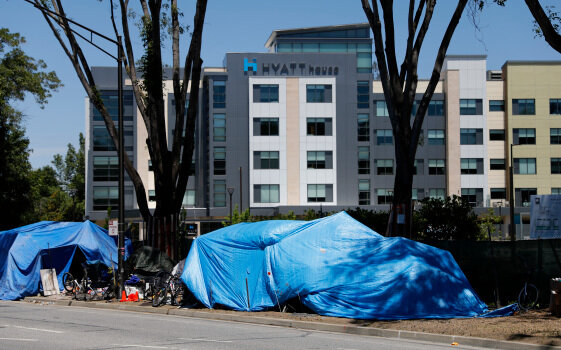
Fact: High housing costs are the driving cause of homelessness
A 2023 UC San Francisco survey of the homeless found that “for most of the participants, the cost of housing had simply become unsustainable.” In particular, 70% of respondents believed that a monthly rental subsidy or one-time payment would have prevented them from going homeless. Additionally, two University of Washington professors have published research indicating that housing market conditions of a particular city/region overwhelmingly predicted the homeless rate, especially compared to other factors like poverty, drug use, and mental illness.

Fact: Our housing shortage is hurting the environment
High housing costs in desirable areas require commuters who cannot afford these areas to live far away from their work or education. UC Berkeley’s Terner Center found that directly correlates with higher vehicle miles traveled, which naturally increases emissions. Car emissions worsen local air quality as well as contribute to climate change, both of which hurt our surrounding environment. Additionally, housing unaffordability can have recursive effects on car usage. A study of Portland’s transit ridership drop found that low income individuals often used public transit for a variety of trips, but were pushed out as the inner-city became too expensive. These low income earners had to move out to the suburbs, where public transportation was less accessible that thus required a car. Meanwhile, the higher income earners who moved in place of the low income individuals often used public transit less, even when given the opportunity to do so. Thus, as low income individuals are pushed out of their homes due to high prices, car usage gets worse.
By contrast, new high density housing actually reduces pollution. The Terner Center study found that these types of housing “help use energy, land, and materials more efficiently.” Furthermore, mixed use and denser housing types encourage biking and walking, which reduces the need for using a car. Ultimately, research by UC Berkeley and Davis in 2018 (cited by the Terner Center Study) found that “building infill housing” would be “the most potent climate action available to local policymakers.”
A separate study conducted by researchers at UC Santa Cruz found that another result of unaffordable housing in the Bay Area displacing low income families is that these families often move to new residences in high wildfire risk areas. This has devastating consequences, as “housing in California’s [wildlife-urban interface] is both the leading cause and casualty of wildfire.” Furthermore, this displacement causes urban sprawl, which fragments wildlife preserves and endangers habitats for local animals.

Fact: California’s housing crisis disproportionately affects communities of color
The Bay Area has a history of racial segregation. Like many cities in the 1930s, the Home Owner’s Loan Corporation issued colored maps that divided San Jose, San Francisco, and Oakland by property values and race to assess the “risk” of investment, a practice known as redlining. Developers participated in discrimination too; a Stanford study done on historic house deeds in Santa Clara County found that “24,522 lots…were subject to racial covenants,” and in 1940, “nearly 30% of all properties [in Santa Clara County] were covered by a racial covenant.” Furthermore, the HOLC would actively deny mortgages to anyone not living in an all-white neighborhood, which created inequalities in the levels of investments to parts of the Bay Area. Ultimately, these deliberate actions to exclude minorities segregated neighborhoods and cities and created distinct inequalities in quality of life. UC Berkeley’s Department of Public Health explained that redlined neighborhoods have worse air, water, and noise pollution, fewer green spaces, and worse outcomes for women’s reproductive health.
Today’s housing crisis reflects the past issues of segregation. The Gender Equity Policy Institute explained in 2024 that “white householders are 1.8 times as likely as Black householders and 1.4 times as likely as Latino householders to own their homes.” Furthermore, Black homeownership has decreased 9% since 1970. Inequalities in rent are stark as well. Black households experience the highest levels of rent burden (65%), and a separate California Housing Partnership analysis found that black renters were twice as likely to be severely cost burdened as white households. Ultimately, the Bay Area Equity Atlas found in 2023 that black and latino residents are “overrepresented among the [Bay Area]’s very low income and low-income families.” Thus, from 2010 to 2020, “the Bay Area lost over 5,000 Black owner-occupied households” with Black renters and homeowners displaced due to the “regionwide housing crisis”.
California’s continuing segregation-through-unaffordability shows itself in Cupertino. UC Berkeley’s Othering and Belonging Institute explained in 2020 that Cupertino was the “largest city in the top 10 [most segregated cities].” In particular, Cupertino scored a 0.429 on inter-municipal divergence, meaning the residents of Cupertino are highly segregated from the rest of the region. A look at Cupertino’s demographics confirm this number: over 90% of the population is either white or Asian, with Black and Hispanic residents making up just under 5% of Cupertino’s population. The Othering Belonging Institute attributed this level of segregation to Cupertino being a city “with a higher-than-average percentage of single-family-only zoning.”